Direct Answer
4 Decision Dimensions for Choosing a Hydraulic Lifting Table
- Load capacity. Size the rated load above your heaviest real load — never run a table at 100% of its limit.
- Platform size and travel. The tabletop must fit your goods and pallets, and the lift stroke must reach your target working height.
- Fixed vs mobile. Permanent workstation or moving loads between stations changes the whole machine design.
- Power source. Electric tables need a battery or mains supply; hydraulic pump tables suit lighter, occasional duties.
Start with the heaviest load and the highest working height, then filter by power source and mobility — every other specification follows from those four answers.
Capacity and Platform Matching by Application
Match the table to what you actually lift. Add 20-30% capacity margin for safety and future loads.
| Application | Typical load | Recommended class | Chenma example |
|---|---|---|---|
| Production line / assembly | 150-500 kg, frequent lifts to elbow height | Compact electric or hydraulic table, short travel | CMLM-H11 (150/300 kg) or CMLM-H10 (500 kg) |
| Warehouse loading / unloading | 200-1000 kg, pallet and cart level | Electric table with tall travel (90-130 cm) | CMLM-E12 (200/300/1000 kg) |
| Heavy-duty moving / repositioning | Over 1000 kg or bulky assemblies | Mobile or heavy-duty electric table, or forklift | Pair a table with a Chenma forklift (up to 2000 kg) |
Lifting Table vs Forklift / Stacker: Division of Work
They both lift — but they solve different problems. Choose the tool that fits the workflow, not the biggest machine.
| Criterion | Hydraulic lifting table | Forklift / stacker |
|---|---|---|
| Best at | Fixed-position vertical lifting at a workstation | Moving and stacking loads across a facility |
| Typical travel | 0.3 - 1.3 m vertical stroke | 1.3 - 5 m+ lift plus horizontal travel |
| Operator skill | Low — press a button or pump a lever | Higher — trained and certified operators |
| Space | Stays in one footprint at the workstation | Needs aisles and turning space |
| Rule of thumb | Loads come to the lift | The lift goes to the loads |
Fixed vs Mobile: Decision Framework
Three questions decide it: does the load position change? Is the floor smooth? How often is the table used?
Choose a fixed table when
- The workstation never moves and loads arrive at the same position.
- You need the lowest platform height for stable, high-capacity lifting.
- Mains power is available and a permanent electrical connection is acceptable.
- Maximizing rigidity and load capacity matters more than portability.
Choose a mobile table when
- Loads move between stations, or a table must serve several lines.
- You work in different zones across a shift and need one unit.
- Battery-powered operation (e.g. 12V lead-acid) is preferred to avoid wiring.
- The floor is smooth enough for casters to roll loaded tables safely.
8 Questions to Ask Before You Buy
Work through this checklist with any supplier — including us — before ordering.
Capacity margin — is the rated load at least 120% of your heaviest real load?
Travel & working height — does the lift stroke reach your target height from the lowest platform position?
Platform size — do your pallets, totes or assemblies sit fully on the tabletop?
Power source — battery (voltage and Ah) or mains? Is the motor power (W) adequate for duty frequency?
Safety devices — overload protection, anti-pinch edges, limit switches and emergency stop fitted?
Mobility — fixed or mobile? Caster load rating and floor conditions confirmed?
Certification — CE certification and documentation for your market available?
After-sales — spares, manuals and warranty response time defined in writing?
Chenma Lifting Tables for Every Duty
Chenma's CE-certified range covers electric table lifts with tall travel for loading docks, and hydraulic table lifts for compact workstation lifting.
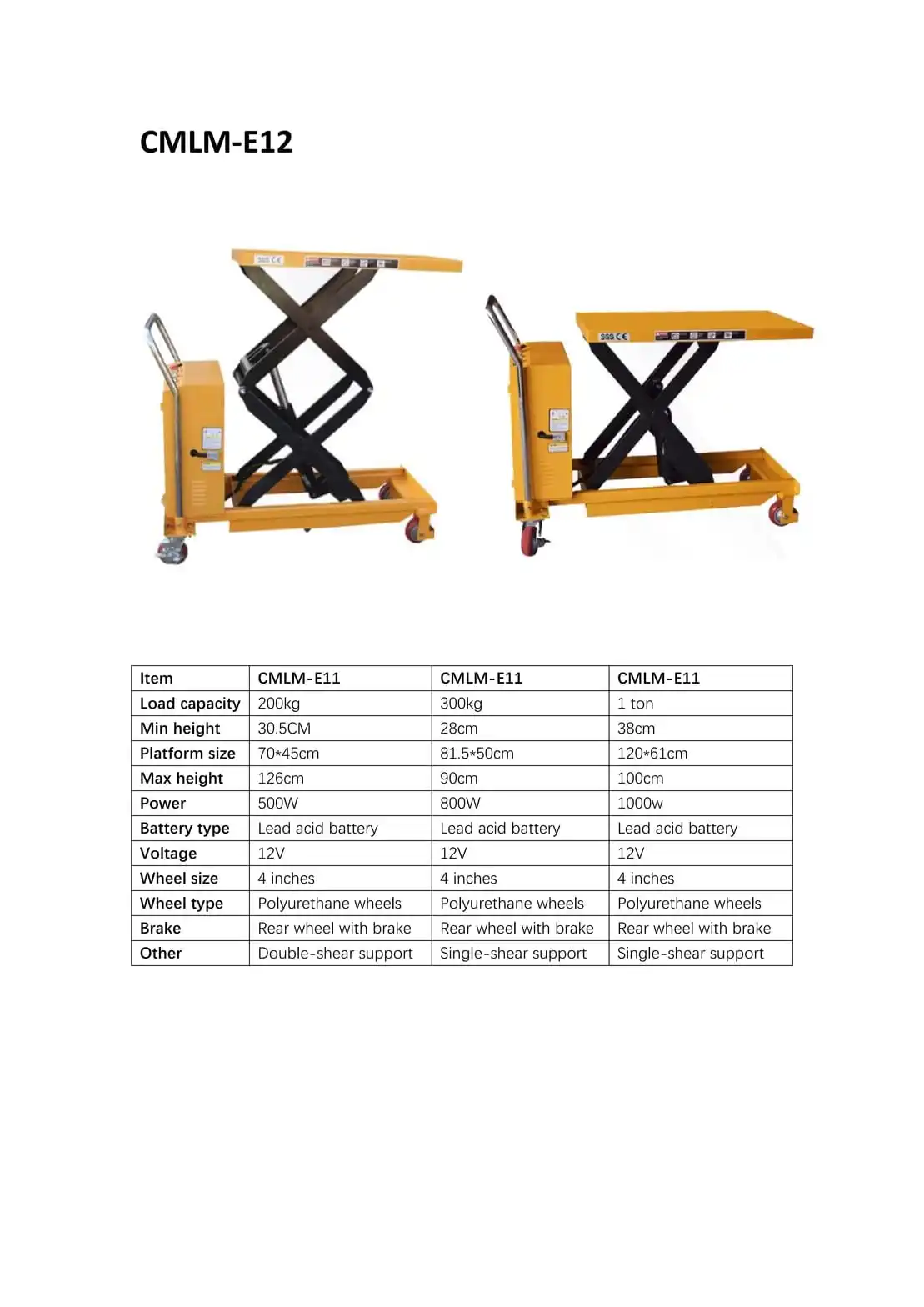
CMLM-E12 Electric Table Lift
Battery-powered table lift for loading and tall-travel duty
- Capacity: 200 / 300 / 1000 kg
- Lift height: 126 / 90 / 100 cm
- Power: 500 / 800 / 1000 W
- Battery: 12V lead-acid
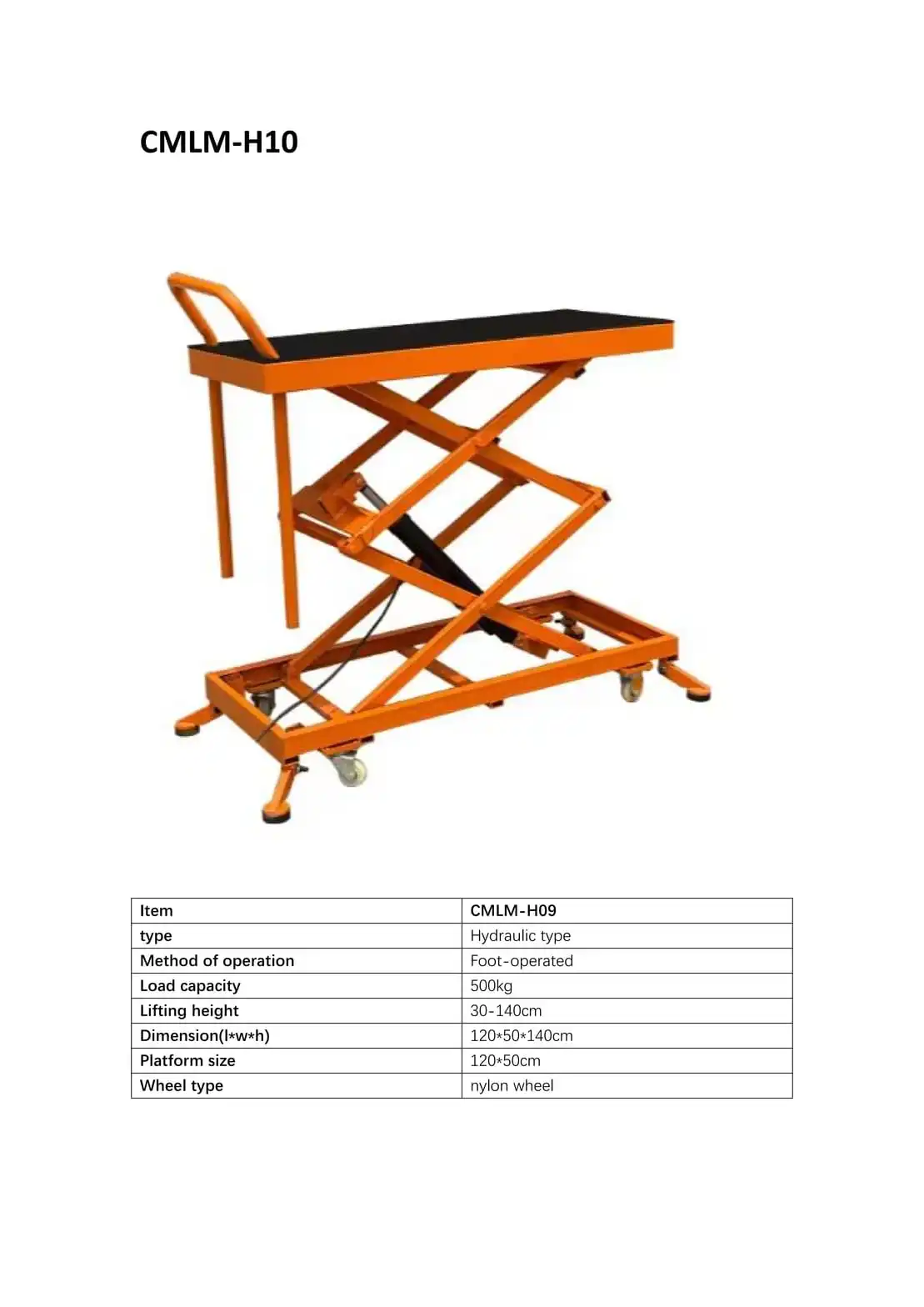
CMLM-H10 Hydraulic Table Lift
Compact hydraulic lift for workstation assembly
- Capacity: 500 kg
- Lift height: 30 - 40 cm
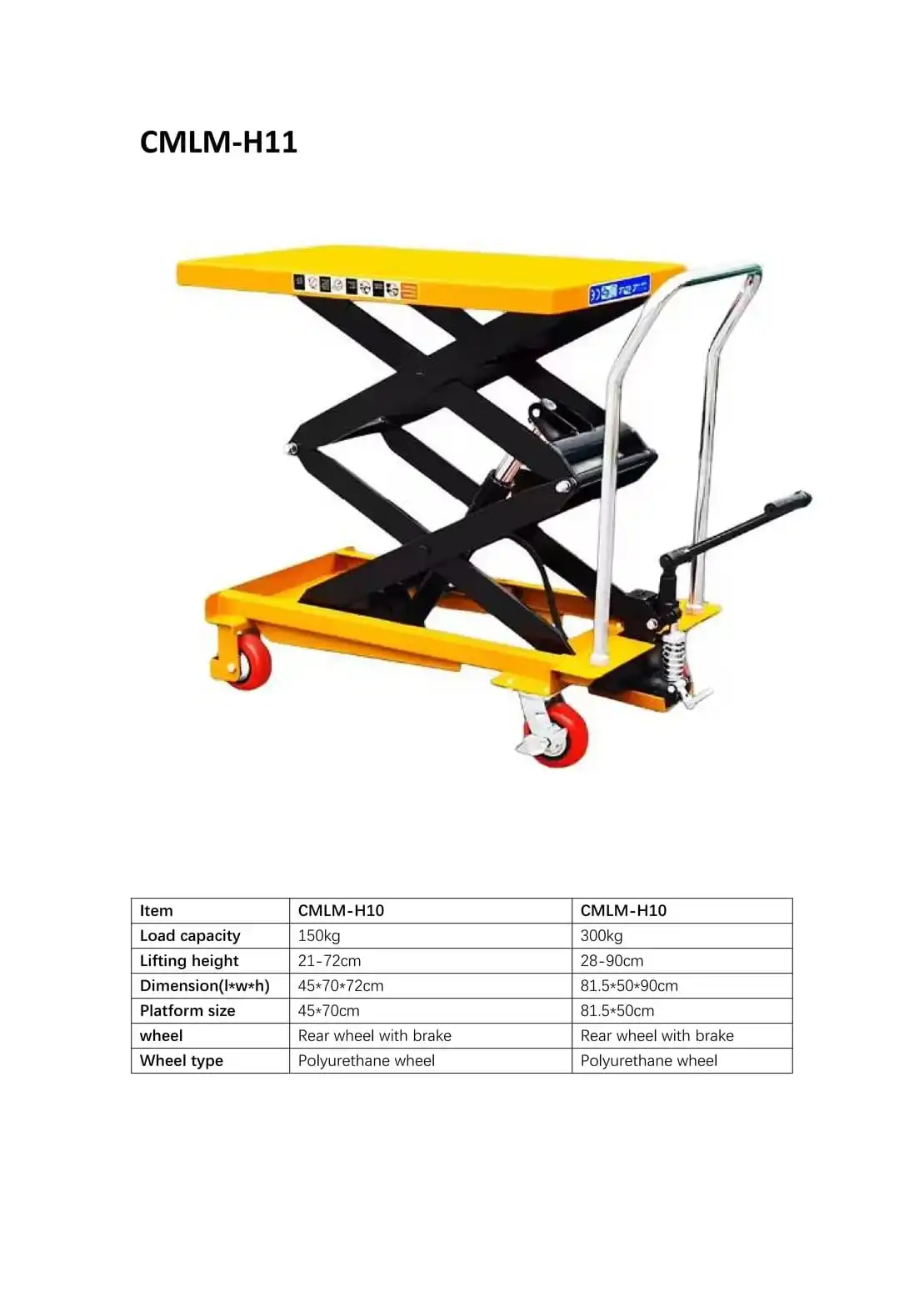
CMLM-H11 Hydraulic Table Lift
Light-duty hydraulic lift with two capacity options
- Capacity: 150 / 300 kg
- Lift height: 21-22 cm (150 kg) / 28-30 cm (300 kg)
Frequently Asked Questions
What is a hydraulic lifting table and when should I use one?
A hydraulic lifting table is a ground-level lifting device that raises loads to a working height for loading, assembly or material handling. Unlike an aerial work platform, a lifting table carries goods, not people. Use one when you repeatedly lift heavy items a short distance at a fixed workstation.
What are the specifications of the Chenma CMLM-E12 electric table lift?
The Chenma CMLM-E12 Electric Table Lift offers load capacities of 200 kg, 300 kg or 1000 kg with lift heights of 126 cm, 90 cm or 100 cm respectively, powered by 500 W, 800 W or 1000 W motors and a 12V lead-acid battery.
What is the load capacity of the Chenma CMLM-H10 hydraulic table lift?
The Chenma CMLM-H10 Hydraulic Table Lift carries 500 kg and provides a lift height of 30 to 40 cm. The CMLM-H11 offers 150 kg (21-22 cm lift) or 300 kg (28-30 cm lift) configurations.
Should I choose a fixed or mobile lifting table?
Choose a fixed table for a permanent workstation with repeated lifting at one position. Choose a mobile table when loads must be moved between stations or loaded directly from a cart or pallet truck, and confirm the floor is smooth enough for the casters.
Disclaimer: This guide provides general industry guidance for selecting hydraulic lifting tables. Lifting tables are designed to carry goods — never use one to raise people unless it is explicitly certified for passenger use. Always confirm load ratings, travel, power source and safety devices with the manufacturer before purchase, and follow the operator's manual after installation.